
This website uses cookies
We use cookies to personalise content and ads, to provide social media features and to analyse our traffic. We also share information about your use of our site with our social media, advertising and analytics partners who may combine it with other information that you’ve provided to them or that they’ve collected from your use of their services.
Consent Selection
Details
  • Necessary cookies help make a website usable by enabling basic functions like page navigation and access to secure areas of the website. The website cannot function properly without these cookies.
  • Preference cookies enable a website to remember information that changes the way the website behaves or looks, like your preferred language or the region that you are in.
    • We do not use cookies of this type.

  • Statistic cookies help website owners to understand how visitors interact with websites by collecting and reporting information anonymously.
    • We do not use cookies of this type.

  • Marketing cookies are used to track visitors across websites. The intention is to display ads that are relevant and engaging for the individual user and thereby more valuable for publishers and third party advertisers.
    • We do not use cookies of this type.

  • Unclassified cookies are cookies that we are in the process of classifying, together with the providers of individual cookies.
    • __emg_sidPending
      Maximum Storage Duration: 1 dayType: HTTP Cookie
      __emg_vidPending
      Maximum Storage Duration: 1 yearType: HTTP Cookie
      nl-read-countPending
      Maximum Storage Duration: PersistentType: HTML Local Storage
Cookie declaration last updated on 8/12/26 by Cookiebot
[#IABV2_TITLE#]
[#IABV2_BODY_INTRO#]
[#IABV2_BODY_LEGITIMATE_INTEREST_INTRO#]
[#IABV2_BODY_PREFERENCE_INTRO#]
[#IABV2_BODY_PURPOSES_INTRO#]
[#IABV2_BODY_PURPOSES#]
[#IABV2_BODY_FEATURES_INTRO#]
[#IABV2_BODY_FEATURES#]
[#IABV2_BODY_PARTNERS_INTRO#]
[#IABV2_BODY_PARTNERS#]
About
Cookies are small text files that can be used by websites to make a user's experience more efficient.

The law states that we can store cookies on your device if they are strictly necessary for the operation of this site. For all other types of cookies we need your permission.

This site uses different types of cookies. Some cookies are placed by third party services that appear on our pages.

You can at any time change or withdraw your consent from the Cookie Declaration on our website.

Learn more about who we are, how you can contact us and how we process personal data in our Privacy Policy.

Please state your consent ID and date when you contact us regarding your consent.
NewsLayer.com

Tether’s USDT Supply Shrinks by $4B in 60 Days as Crypto Demand Cools

Đăng 19 phút trước 2 phút đọc
Tether’s USDT Supply Shrinks by $4B in 60 Days as Crypto Demand Cools

Tether’s USDT Supply Shrinks by $4B in 60 Days as Crypto Demand Cools Cryptonews.net

Tether Sheds $870M in 11 Days as Stablecoin Demand Weakens

Tether’s $USDT supply is shrinking after years of rapid expansion, adding to signs that some crypto capital is moving offchain rather than simply rotating between stablecoins.

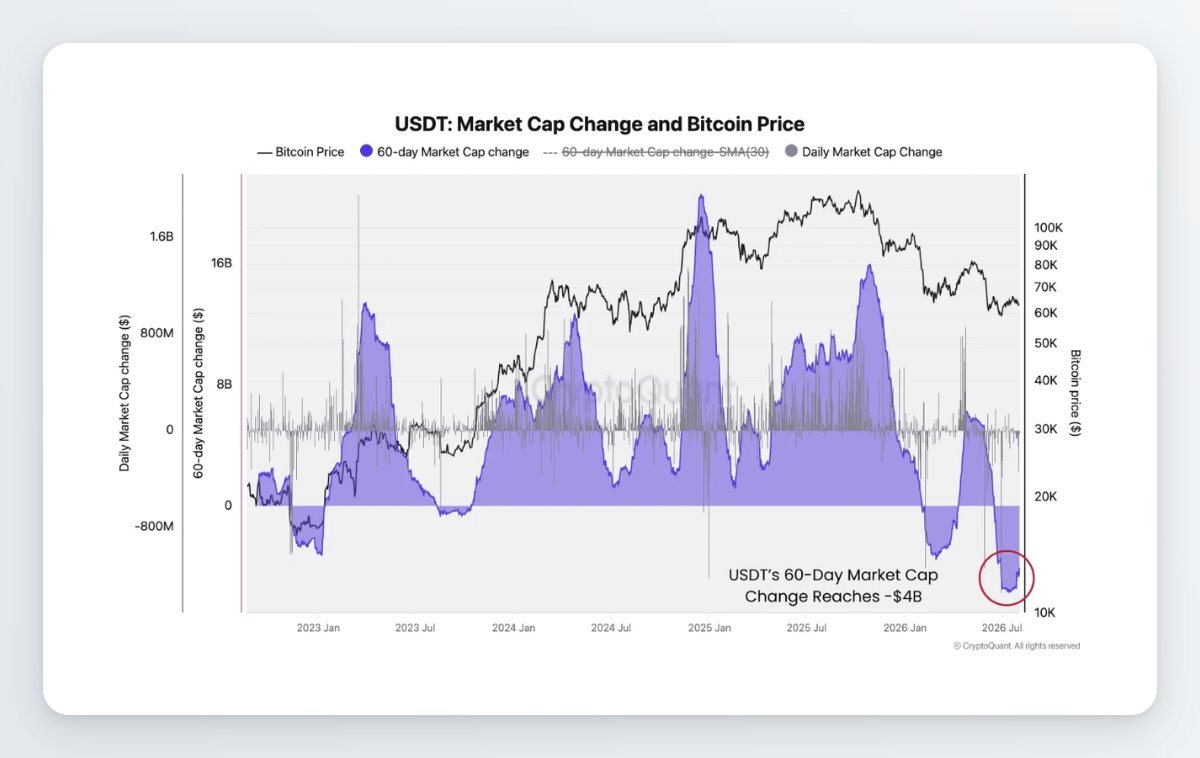
Cryptoquant data shows $USDT’s 60-day rolling supply change at roughly negative $4 billion. About $870 million of that decline occurred over the past 11 days.

$USDT remains the dominant stablecoin, with around $184 billion in circulation and an estimated 60% share of total stablecoin supply. Still, the recent contraction has raised questions about whether investors are reducing exposure to crypto altogether.

Analyst Stacy Muur said part of the move appears to be a direct exit into fiat following bitcoin’s retreat from its 2025 peak. “Some investors are redeeming stablecoins for fiat and leaving crypto entirely,” she said.
Source: Cryptoquant

Yield Competition Is Only Part of the Story

Changing stablecoin economics may also be contributing. $USDC offers a broader rewards ecosystem through platforms such as Coinbase, while lending protocols, including Morpho and Aave provide additional yield opportunities.

However, Muur noted that $USDC supply has also fallen sharply. That weakens the argument that capital is simply switching from Tether into Circle’s stablecoin.

“I think it’s just a mix of things,” she said. “Some capital chasing yield, some rotating back into fiat, and less demand for stablecoins as speculative activity cools.”

That distinction matters because stablecoins are often treated as a proxy for deployable crypto liquidity. A broad decline across major issuers can signal that capital is leaving digital-asset markets rather than waiting on the sidelines.

Tron and Ethereum Still Dominate $USDT

Despite the decline in supply, $USDT remains heavily concentrated on two networks. Tron and Ethereum each host roughly $90 billion of Tether, together accounting for about 97% of the token’s circulating supply.

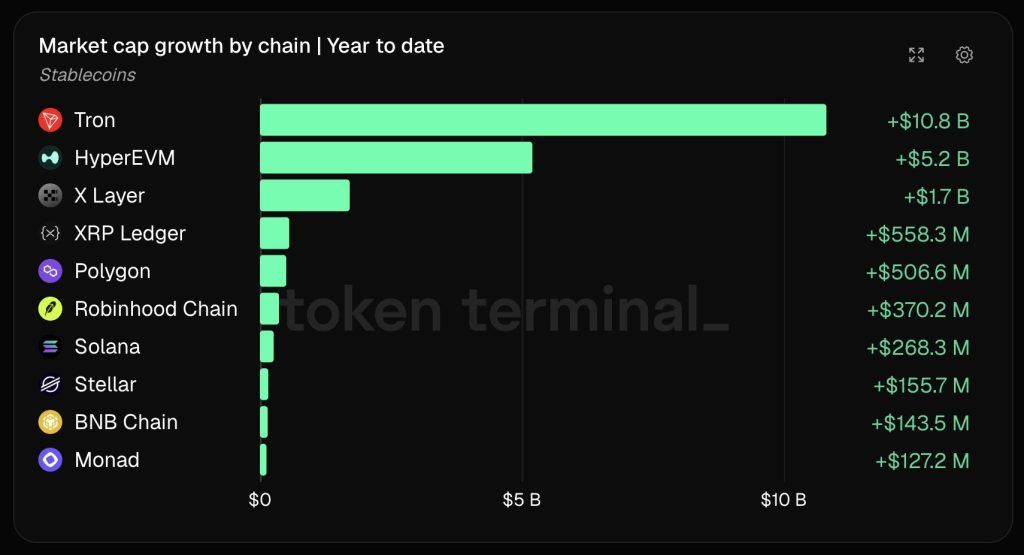
Tron has also led stablecoin growth so far this year. Its stablecoin market capitalization has increased by about $10.8 billion, ahead of HyperEVM at $5.2 billion and X Layer at $1.7 billion.

Source: Token Terminal

The broader picture is therefore mixed. Tether remains deeply embedded in crypto payments, trading, and emerging-market dollar demand, but aggregate supply is no longer expanding in a straight line.

For investors, the more important signal may be whether shrinking stablecoin balances are followed by weaker trading activity and liquidity. If so, the latest $USDT contraction could mark a broader cooling in crypto risk appetite rather than a temporary reshuffling of digital dollars.

Attribution

Originally reported by Cryptonews.net

Get stories like this, daily.

Daily crypto + regulation intelligence, straight to your inbox. Free.

Tin Liên Quan