
Bitcoin's calm near $62,941 masks a split in Bitcoin futures positioning: either a downside break or an upside breakout could gain speed from forced trades.
At 09:30 UTC on Aug. 15, CoinGlass showed $47.88 billion of Bitcoin open interest, $38.49 billion of 24-hour futures volume and $2.234 billion of spot volume. Futures turnover was 17.23 times CoinGlass's spot-volume measure during the same rolling window.
The ratio measures relative trading activity. Open interest measures contracts that remain outstanding, and every contract has a long and a short. The aggregate therefore leaves direction unresolved.
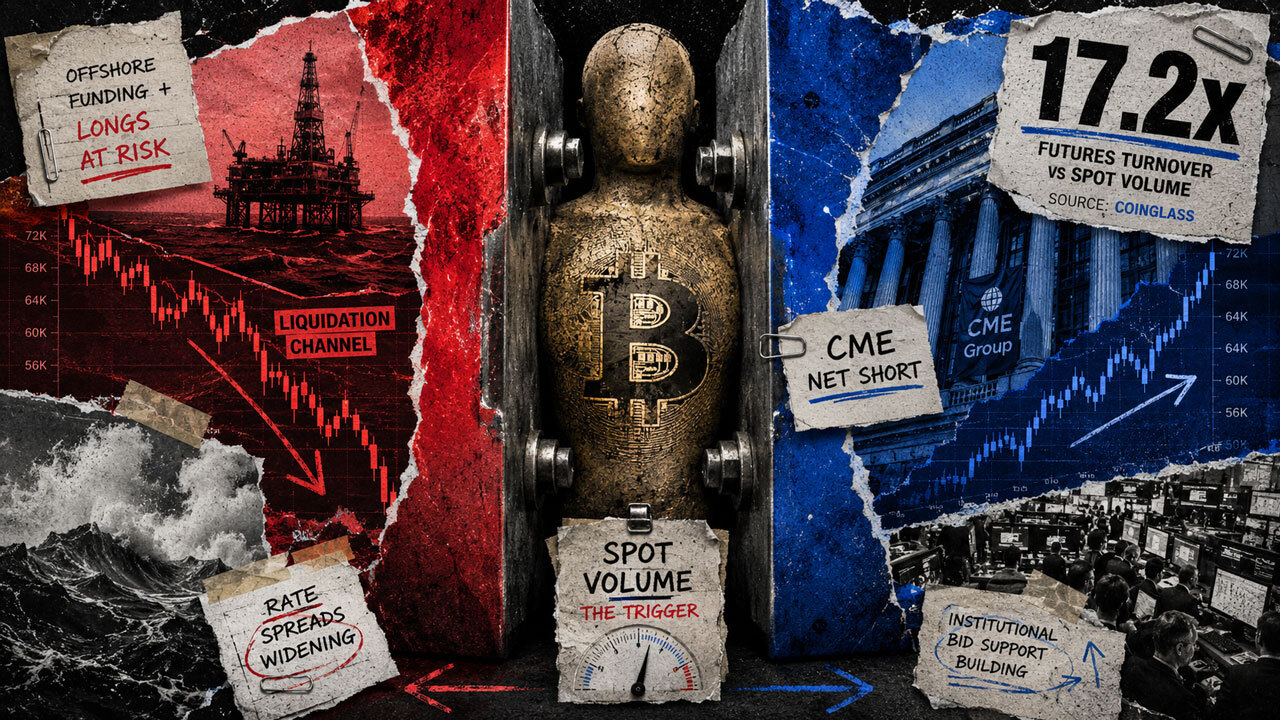
The directional evidence splits across markets. Small positive funding on offshore perpetuals exposes longs if price falls, while a large net-short position among CME leveraged funds creates covering demand if price rises. The first side forced to retreat will depend on which range boundary attracts enough cash-market demand or supply to keep Bitcoin moving.
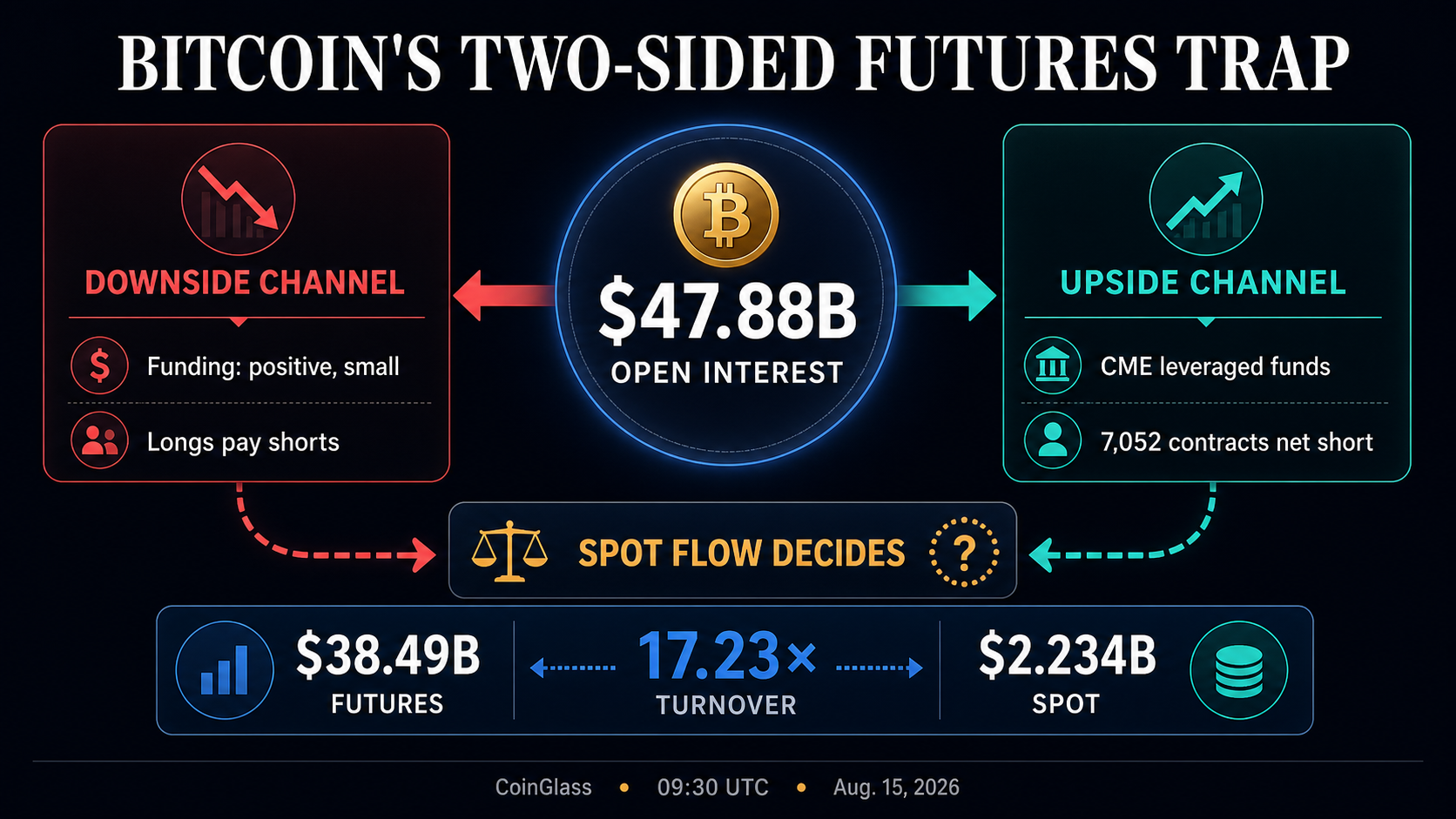
Bitcoin futures positioning points in opposite directions
| Signal | Observed state | Potential forced flow |
|---|---|---|
| CoinGlass activity | $47.88B open interest; futures volume 17.23 times its spot measure | A sustained range break can transmit through a large derivatives market |
| Offshore funding | Positive but small on OKX and Deribit | Falling prices can prompt leveraged longs to close |
| CME positioning | Leveraged funds net short 7,052 outright standard contracts | Rising prices can prompt short covering |
| US spot ETF flows | -$385.2M from Aug. 10-14; +$480.1M from Aug. 3-14 | Recent demand weakened within a still-positive wider August window |
Funding supplies the clearest downside channel. OKX showed a current-period BTC-USDT perpetual rate of about 0.00752%, and Deribit showed a smaller positive eight-hour rate in the retained snapshot. Positive rates mean longs paid shorts on those instruments.
A price decline accompanied by closing positions could turn those longs into additional sellers. Falling open interest and a funding reset during such a move would strengthen the evidence that deleveraging was underway.