
This website uses cookies
We use cookies to personalise content and ads, to provide social media features and to analyse our traffic. We also share information about your use of our site with our social media, advertising and analytics partners who may combine it with other information that you’ve provided to them or that they’ve collected from your use of their services.
Consent Selection
Details
  • Necessary cookies help make a website usable by enabling basic functions like page navigation and access to secure areas of the website. The website cannot function properly without these cookies.
  • Preference cookies enable a website to remember information that changes the way the website behaves or looks, like your preferred language or the region that you are in.
    • We do not use cookies of this type.

  • Statistic cookies help website owners to understand how visitors interact with websites by collecting and reporting information anonymously.
    • We do not use cookies of this type.

  • Marketing cookies are used to track visitors across websites. The intention is to display ads that are relevant and engaging for the individual user and thereby more valuable for publishers and third party advertisers.
    • We do not use cookies of this type.

  • Unclassified cookies are cookies that we are in the process of classifying, together with the providers of individual cookies.
    • __emg_sidPending
      Maximum Storage Duration: 1 dayType: HTTP Cookie
      __emg_vidPending
      Maximum Storage Duration: 1 yearType: HTTP Cookie
      nl-read-countPending
      Maximum Storage Duration: PersistentType: HTML Local Storage
Cookie declaration last updated on 8/12/26 by Cookiebot
[#IABV2_TITLE#]
[#IABV2_BODY_INTRO#]
[#IABV2_BODY_LEGITIMATE_INTEREST_INTRO#]
[#IABV2_BODY_PREFERENCE_INTRO#]
[#IABV2_BODY_PURPOSES_INTRO#]
[#IABV2_BODY_PURPOSES#]
[#IABV2_BODY_FEATURES_INTRO#]
[#IABV2_BODY_FEATURES#]
[#IABV2_BODY_PARTNERS_INTRO#]
[#IABV2_BODY_PARTNERS#]
About
Cookies are small text files that can be used by websites to make a user's experience more efficient.

The law states that we can store cookies on your device if they are strictly necessary for the operation of this site. For all other types of cookies we need your permission.

This site uses different types of cookies. Some cookies are placed by third party services that appear on our pages.

You can at any time change or withdraw your consent from the Cookie Declaration on our website.

Learn more about who we are, how you can contact us and how we process personal data in our Privacy Policy.

Please state your consent ID and date when you contact us regarding your consent.
NewsLayer

Install NewsLayer

Get the app experience — one tap from your home screen, instant loads and breaking-news alerts.

NewsLayer.com
NewsLayer PulseLIVEBTC$64,896+1.14%ETH$1,937+2.08%SOL$78.49+2.99%XRP$1.01+1.29%DOGE$0.0706+1.24%ADA$0.1755+0.87%Total Cap$2.31T+0.95%Layer Index45 Neutral
External ReportingYayınlandı 3 saat önce

IBM moves a step closer to fault-tolerant quantum computing by linking its first modular cryogenic fridges

IBM Corp. said today it has taken a massive step forward toward its goal of delivering the world’s first fault-tolerant quantum computer by 2029, after successfully linking and cooling down the first pair of modules based on a new,…

IBM moves a step closer to fault-tolerant quantum computing by linking its first modular cryogenic fridges
Publisher SiliconANGLE 4 dk okuma
Image via SiliconANGLE

Layer Index

45

IBM Corp. said today it has taken a massive step forward toward its goal of delivering the world’s first fault-tolerant quantum computer by 2029, after successfully linking and cooling down the first pair of modules based on a new, highly scalable cryogenic architecture.

The new system makes it possible for hundreds of quantum processors to be linked together into a giant cluster, paving the way for large-scale quantum computers that can actually make a difference.

IBM said the achievement is a key milestone on its roadmap toward the delivery of IBM Quantum Starling, which is a new quantum computing system that’s currently under development and slated to launch in three years. It’s envisaged that Starling will be able to perform about 20,000 times more calculations than today’s existing quantum computers, making it powerful enough to deliver the Holy Grail of “quantum advantage.” That’s the threshold where these machines will be able to solve complex, real-world problems that existing classical supercomputers cannot do.

Quantum computers derive their incredible computing power from so-called “qubits,” which are the quantum version of traditional bits found in classical computers. With classical computers, the bits can represent either a 1 or a 0, whereas qubits can be a 1 or a 0, or both at the same time. They can do this because they take advantage of a principle in quantum mechanics known as “superposition,” and that enables them to process vast amounts of multidimensional data at such ungodly speeds.

The problem is that no one has been able to build a functional quantum computer so far, or at least, not at a scale that’s big enough to make a difference. That’s because these qubits are so incredibly fragile. They’re susceptible to basically any amount of “noise,” including things as subtle as a slight drop in temperature, electromagnetic interference, vibrations caused by someone walking across a room, or even the fluctuations of the Earth’s magnetic field. When they’re disturbed by this noise, qubits suddenly lose their quantum state – a process known as decoherence – and much of the data they store is lost, resulting in errors in quantum calculations.

IBM is trying to solve this challenge with “logical qubits,” so rather than use a single, error-prone qubit, engineers bunch together multiple physical qubits together with advanced error correction codes, which allows them to act as a single, reliable qubit. It’s a form of redundancy that ensures quantum computers can still process calculations correctly, even if some of the individual qubits fail.

But this solution creates new problems – to build a quantum computer that can achieve quantum advantage, IBM needs to have thousands of qubits all working in tandem. To protect these qubits, they must be housed in shared spaces and cooled to extreme temperatures close to absolute zero.

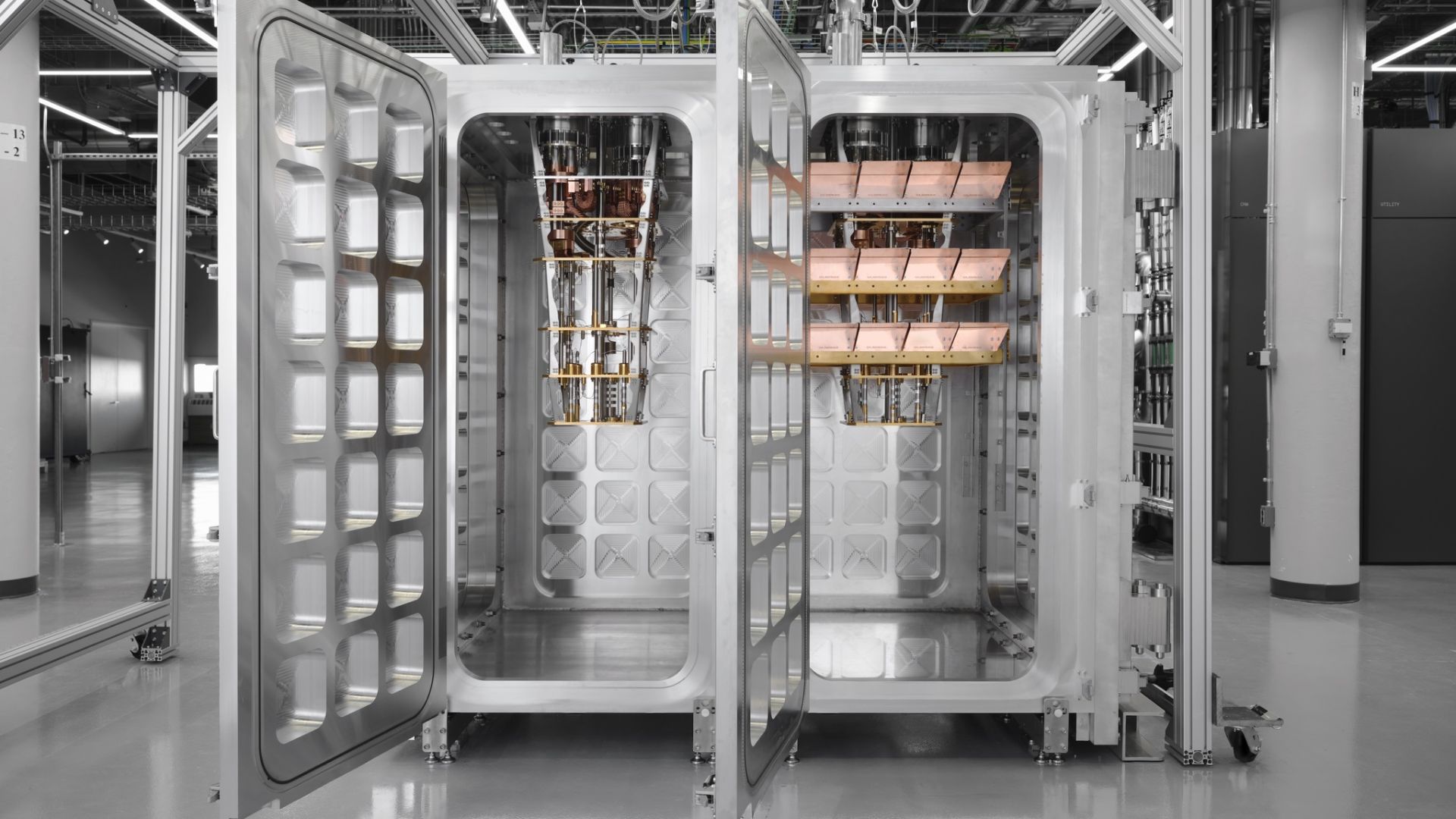
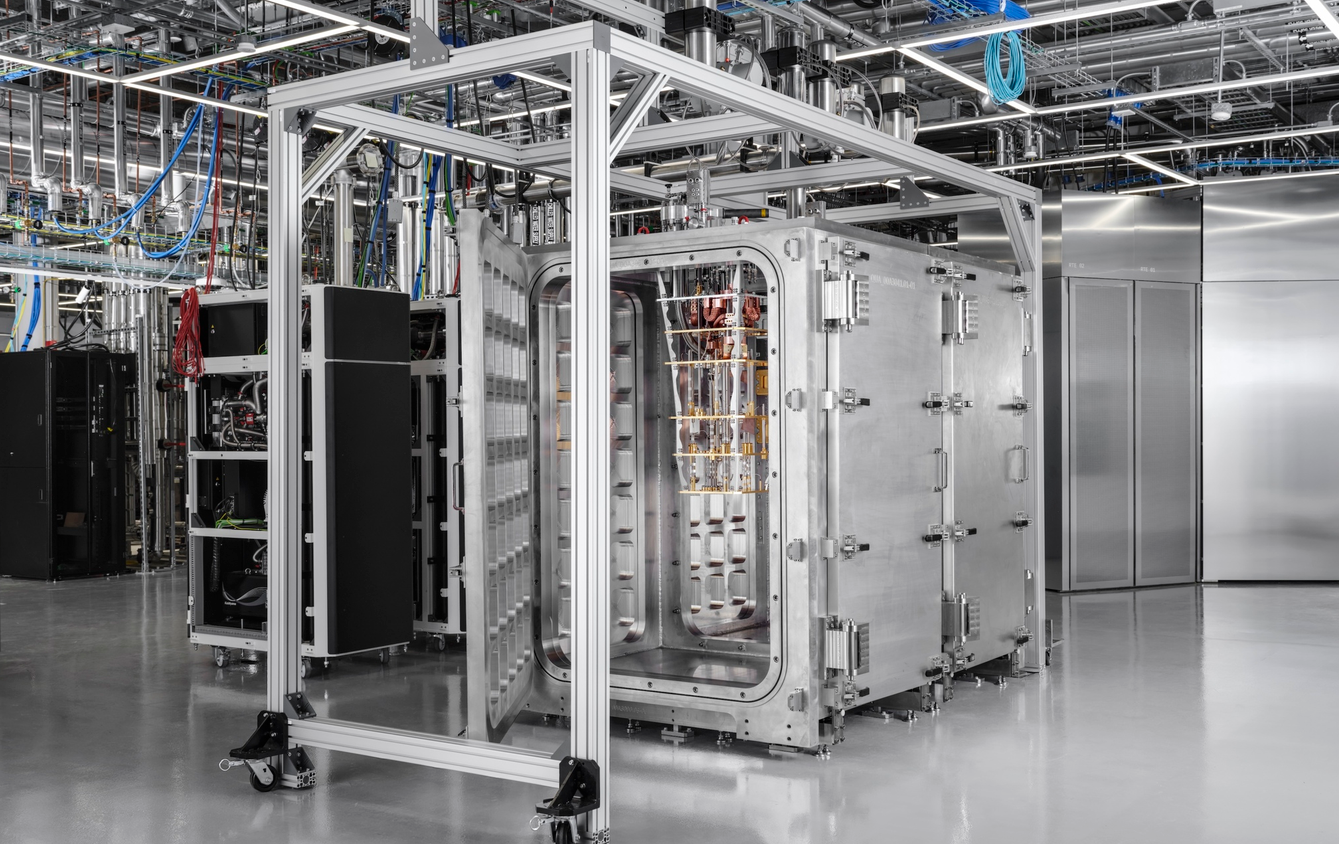
That’s why IBM’s new cryogenic modules are such a vital component. They’re cooled to below 15 millikelvin, which is more than 180 times colder than deep space. They’re massive too, with the first pair of modules at IBM’s facility in Poughkeepsie, New York, standing at eight feet tall and eight feet wide.

Unlike traditional cylindrical cryogenic fridges, the new modules are shaped like boxes so they can be packed together in tight rows. Within each module is an enclosure that’s 12 times larger than existing systems, which means there’s ample room to connect hundreds of quantum processors, where the individual qubits live. They’re connected together using IBM’s novel L-Coupler technology, which links individual chips into clusters so they can share information and operate as one, much larger processor, similar to how today’s graphics processing unit clusters work together in artificial intelligence data centers.

Another advantage of the new cryogenic modules is that they make it easier for individual processors to be maintained and upgraded, without affecting the performance of the cluster they’re a part of.

IBM Research Director Jay Gambetta said today’s announcement is just one of several fundamental advances the company needs to make before it can bring its first fault-tolerant quantum computer online. “The successful connection and operation of these cryogenic modules signals a leap forward in that direction and will accelerate our progress alongside continued innovation in quantum hardware, software and algorithms,” he said.

Today’s milestone suggests that IBM remains on course to meet its ambitious roadmap and launch the Starling system before the end of the decade.

Photo: IBM

A message from John Furrier, co-founder of SiliconANGLE:

Support our mission to keep content open and free by engaging with theCUBE community. Join theCUBE’s Alumni Trust Network, where technology leaders connect, share intelligence and create opportunities.

  • 15M+ viewers of theCUBE videos, powering conversations across AI, cloud, cybersecurity and more
  • 11.4k+ theCUBE alumni — Connect with more than 11,400 tech and business leaders shaping the future through a unique trusted-based network

SiliconANGLE Media is a recognized leader in digital media innovation, uniting breakthrough technology, strategic insights and real-time audience engagement. As the parent company of

SiliconANGLE

,

theCUBE Network

,

theCUBE Research

,

CUBE365

,

theCUBE AI

and theCUBE SuperStudios — with flagship locations in Silicon Valley and the New York Stock Exchange — SiliconANGLE Media operates at the intersection of media, technology and AI.

Founded by tech visionaries John Furrier and Dave Vellante, SiliconANGLE Media has built a dynamic ecosystem of industry-leading digital media brands that reach 15+ million elite tech professionals. Our new proprietary theCUBE AI Video Cloud is breaking ground in audience interaction, leveraging theCUBEai.com neural network to help technology companies make data-driven decisions and stay at the forefront of industry conversations.

Son Dakika

Hiçbir son dakika haberini kaçırmayın

Advertisement

House — Advertise on NewsLayer
NewsLayerAd

Sourced by

Originally reported by SiliconANGLE

NewsLayer coverage based on externally reported material.

The Daily Brief

The onchain economy, before your day starts.

Curated markets, onchain insights, and key headlines — delivered every weekday morning.

Weekdays · Free · ~5 minute read

İlgili Haberler