


OpenAI is previewing Private Safety Processing with early customers seeking greater certainty about how their data will be protected as AI systems become more capable. The system identifies patterns across related interactions while restricting OpenAI personnel from accessing the underlying content. The company plans to start rolling it out and publish a technical white paper in September.
OpenAI previews privacy-focused system for detecting AI misuse
OpenAI is previewing Private Safety Processing with early customers seeking greater certainty about how their data will be protected as AI systems become more capable. The system identifies patterns across related interactions while…
Help Net Security
Publisher
Aug 20, 2026 at 9:09 AM UTC · 2 分で読める
翻訳中…
“No AI lab can address emerging risks alone. Private Safety Processing reflects that approach and is being shaped by customers across industries, regions, and company sizes,” OpenAI wrote.
For eligible API customers using Zero Data Retention (ZDR), prompts and model responses are not retained after a request is processed. An exception applies to images flagged as potential CSAM, which may be retained for manual review and reporting. OpenAI says enterprise customer data is not used to train its models unless customers opt in.
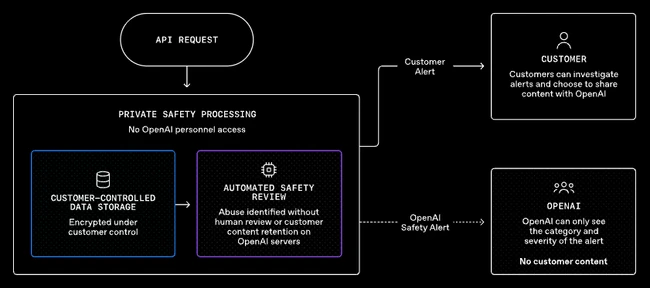
Content Access Controls (Source: OpenAI)
ZDR deployments keep content on infrastructure controlled by the customer. OpenAI is developing another option that would store it on the company’s infrastructure using customer-controlled encryption keys. In both configurations, automated systems can identify potential misuse and return limited safety signals without revealing prompts or responses.
Article Intelligence
Topics
Regulation Signal
in progressUpdated 13日前
SEC Crypto Asset Market Structure RulemakingRelated Coverage
 Artificial IntelligenceA Lawyer for AI Agents2時間前 · 4 min read
 Artificial IntelligenceFinancial Regulator Deploys AI to Monitor Crypto Market 24/75時間前 · 2 min read
 CryptoRipple stock position revealed in SEC fund filing9分前 · 1 min read
Sponsored
Ad
NewsLayerLearn more
NewsLayer Premium
Unlock deeper intelligence.
Ad-free reading, exclusive research, and real-time onchain insights.
Go Premium