
This website uses cookies
We use cookies to personalise content and ads, to provide social media features and to analyse our traffic. We also share information about your use of our site with our social media, advertising and analytics partners who may combine it with other information that you’ve provided to them or that they’ve collected from your use of their services.
Consent Selection
Details
  • Necessary cookies help make a website usable by enabling basic functions like page navigation and access to secure areas of the website. The website cannot function properly without these cookies.
  • Preference cookies enable a website to remember information that changes the way the website behaves or looks, like your preferred language or the region that you are in.
    • We do not use cookies of this type.

  • Statistic cookies help website owners to understand how visitors interact with websites by collecting and reporting information anonymously.
    • We do not use cookies of this type.

  • Marketing cookies are used to track visitors across websites. The intention is to display ads that are relevant and engaging for the individual user and thereby more valuable for publishers and third party advertisers.
    • We do not use cookies of this type.

  • Unclassified cookies are cookies that we are in the process of classifying, together with the providers of individual cookies.
    • __emg_sidPending
      Maximum Storage Duration: 1 dayType: HTTP Cookie
      __emg_vidPending
      Maximum Storage Duration: 1 yearType: HTTP Cookie
      nl-read-countPending
      Maximum Storage Duration: PersistentType: HTML Local Storage
Cookie declaration last updated on 8/12/26 by Cookiebot
[#IABV2_TITLE#]
[#IABV2_BODY_INTRO#]
[#IABV2_BODY_LEGITIMATE_INTEREST_INTRO#]
[#IABV2_BODY_PREFERENCE_INTRO#]
[#IABV2_BODY_PURPOSES_INTRO#]
[#IABV2_BODY_PURPOSES#]
[#IABV2_BODY_FEATURES_INTRO#]
[#IABV2_BODY_FEATURES#]
[#IABV2_BODY_PARTNERS_INTRO#]
[#IABV2_BODY_PARTNERS#]
About
Cookies are small text files that can be used by websites to make a user's experience more efficient.

The law states that we can store cookies on your device if they are strictly necessary for the operation of this site. For all other types of cookies we need your permission.

This site uses different types of cookies. Some cookies are placed by third party services that appear on our pages.

You can at any time change or withdraw your consent from the Cookie Declaration on our website.

Learn more about who we are, how you can contact us and how we process personal data in our Privacy Policy.

Please state your consent ID and date when you contact us regarding your consent.
NewsLayer.com
NewsLayer PulseLIVEBTC$71,386+8.34%ETH$2,272+15.41%SOL$86.2+6.70%XRP$1.24+19.63%DOGE$0.0776+8.98%ADA$0.1932+9.55%Total Cap$2.55T+9.73%Layer Index80 Extreme Greed

IBM Quantum Starling Gets Its First Real Hardware: Two Cold Modules Now Linked

IBM announced Wednesday that it successfully joined and cooled two modular cryogenic units into a single shared cold environment, reaching temperatures below 15 millikelvin — more than 180 times colder than deep space — in what the…

Tech Times

Publisher

Aug 20, 2026 at 12:05 PM UTC · Updated il y a une heure · 13 min de lecture
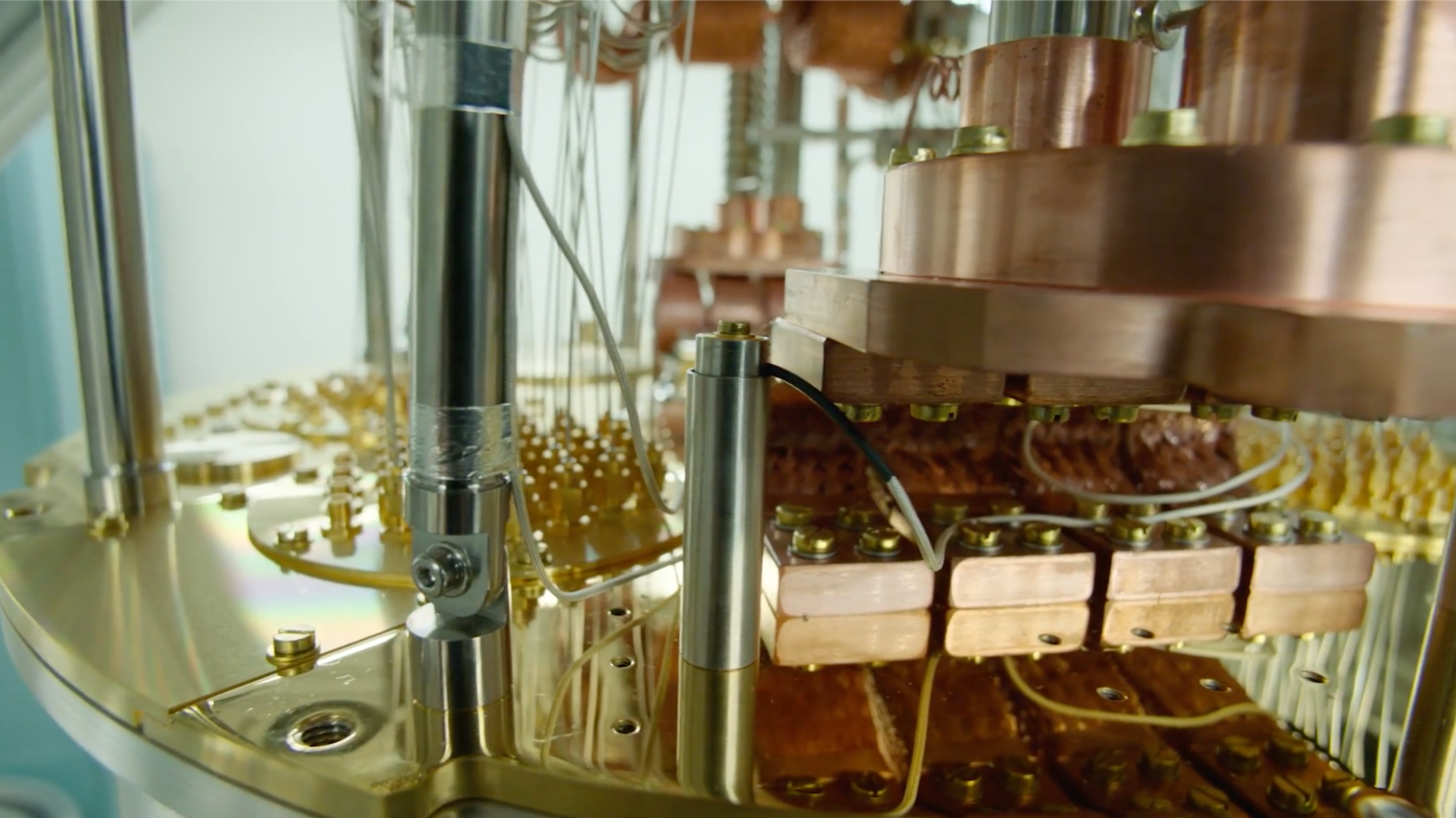
IBM Quantum Starling Gets Its First Real Hardware: Two Cold Modules Now Linked
Image via Tech Times
Traduction…

IBM announced Wednesday that it successfully joined and cooled two modular cryogenic units into a single shared cold environment, reaching temperatures below 15 millikelvin — more than 180 times colder than deep space — in what the company described as a foundational engineering milestone on its path to delivering the world's first fault-tolerant quantum computer by 2029.

The two connected modules stand more than eight feet tall and eight feet wide together. Initial tests showed they jointly cooled to 4 Kelvin — the temperature of liquid helium — in under five days before reaching their final operating temperature. What the announcement actually demonstrated is more significant than its press-release framing suggests: two modules sharing one cold environment is not merely a cooling test. It is the first real proof that the physical container IBM Quantum Starling will need to exist in can actually be built.

To understand why the modular milestone matters, it helps to understand why existing quantum refrigerators are a bottleneck in the first place.

How a Dilution Refrigerator Works — and Why It Stops Scaling

Superconducting quantum computers — the architecture used by IBM, Google, and most of the commercial quantum industry — require their processors to operate at roughly 10 to 20 millikelvin, just a fraction of a degree above absolute zero. That is roughly 150 times colder than the cosmic microwave background radiation, the coldest natural temperature in the observable universe. The device that makes this possible is a dilution refrigerator — explained in detail in IBM's modular cryogenics blog post.

Article Intelligence

Sponsored

Ad
House — Advertise on NewsLayer
NewsLayerLearn more

NewsLayer Premium

Unlock deeper intelligence.

Ad-free reading, exclusive research, and real-time onchain insights.

Go Premium