

A Routine Filing With Alarming Numbers
The quarterly report, covering the three months ended June 30, shows the Grayscale Chainlink Trust ETF (GLNK) holding 10,030,901.11 $LINK tokens as its sole asset. At the fund’s principal-market close, that stake was worth $72.2 million, unchanged in token count from the prior quarter but down sharply in dollar terms as Chainlink’s price slid.
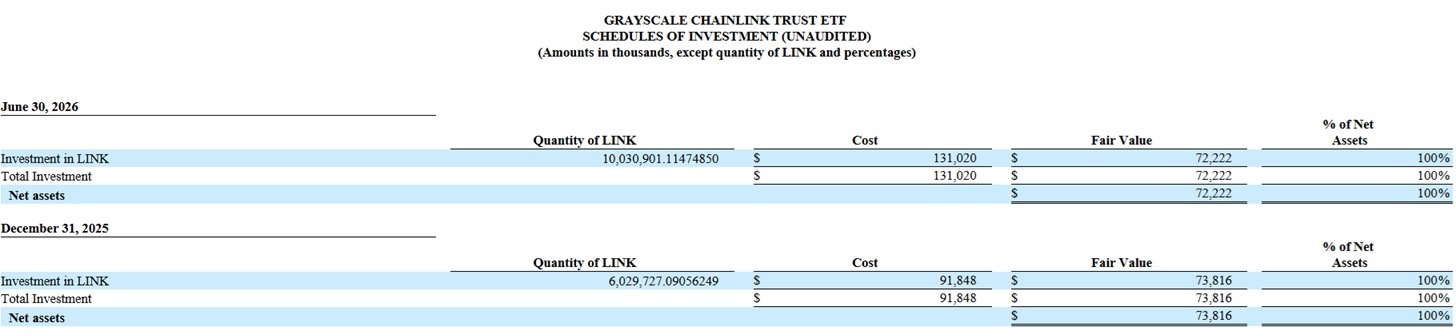
10-Q filings are routine disclosures every U.S.-listed fund must submit each quarter, and GLNK’s paperwork doesn’t break new regulatory ground. But the numbers inside it capture a token that has struggled since institutional investors got direct access to it. GLNK began trading on NYSE Arca on December 2, 2025, converting a Delaware trust that Grayscale had run privately since 2020 into a fund anyone with a brokerage account could buy.
GLNK’s fast route to market traces back to a rule change less than a year old. The SEC approved generic listing standards for crypto exchange-traded products in September 2025, letting exchanges like NYSE Arca list qualifying crypto trust conversions without the individualized rule-filing process that used to take the better part of a year. Grayscale used that faster runway to bring GLNK, along with several other single-asset trust conversions, to market within months.
$LINK’s Rough Quarter
The filing’s most telling figure is the token price marked at quarter-end, which stood at $7.25 (June 30), down from $8.77 when the prior 10-Q was filed in May. That’s an 18% drop in three months, and it dragged the trust’s net asset value (NAV) per share down to $6.38. Grayscale’s own math shows the toll, sitting on an unrealized loss of roughly $16.4 million on the $LINK stake for the quarter alone (even with the token count untouched).
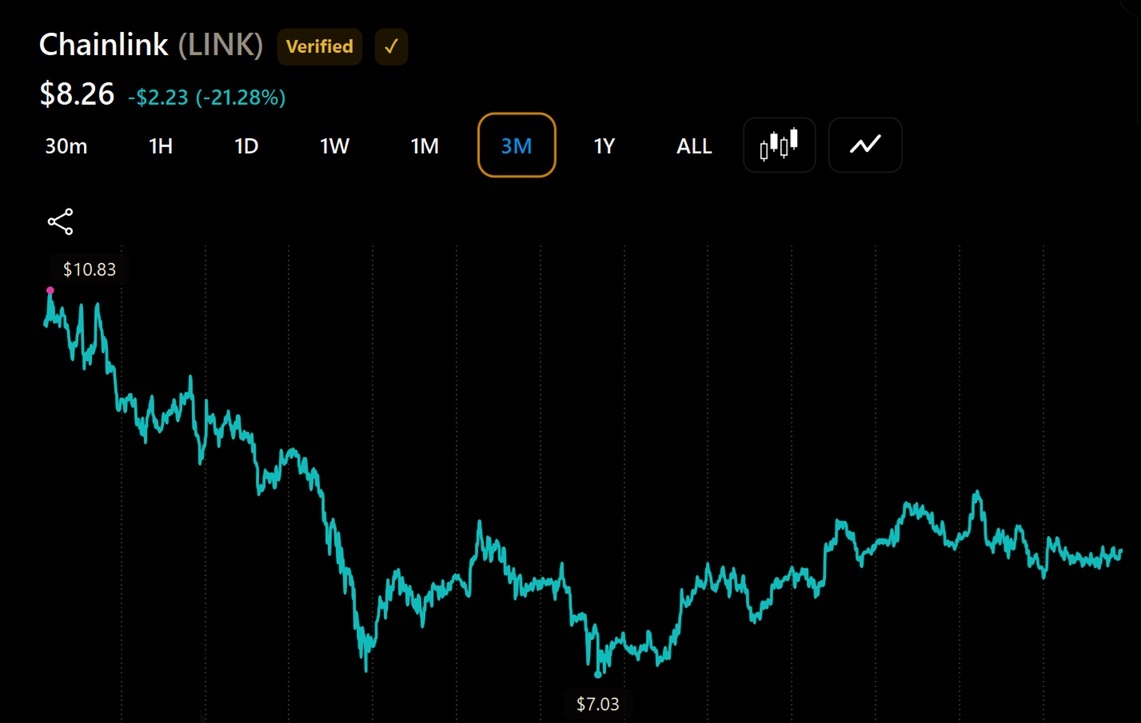
Chainlink, the oracle network that feeds external data and price information to smart contracts on Ethereum and other blockchains, has had a volatile run since GLNK’s launch. And $LINK isn’t alone, given that most altcoins tied to onchain infrastructure have taken a beating this year even though bitcoin ETFs have staged a partial recovery in recent weeks.